Philippines

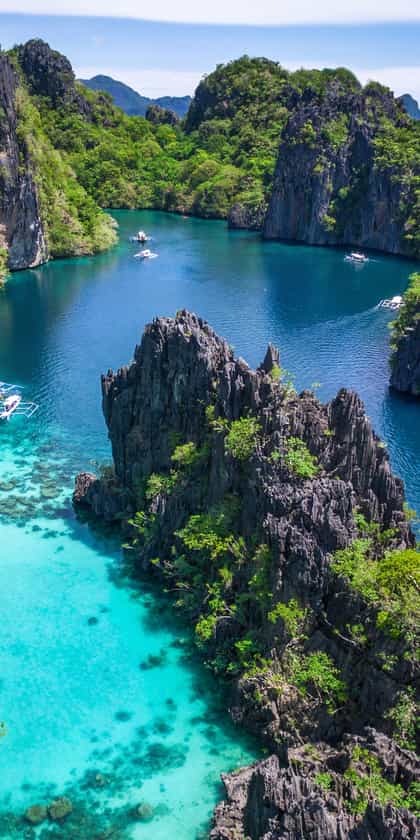
With over 7,000 islands scattered across turquoise seas, the Philippines is an archipelago that defies superlatives. From the chocolate hills of Bohol to the underground rivers of Palawan, this Southeast Asian gem serves up adventure with a generous side of warmth. Think pristine white beaches that would make the Maldives jealous, rice terraces carved into mountainsides like nature's own amphitheatres, and cities that pulse with infectious energy. The Filipino spirit of hospitality is legendary – expect genuine smiles, hearty laughter, and perhaps the most welcoming people on the planet. It's tropical paradise with serious substance.

Seven thousand islands means you'll never run out of beaches, dive sites or reasons to return.

Swap the El Nido crowds for Batanes, where green hills tumble into a wild, windswept northern sea.

Many smaller islands run on cash alone, so stock up before you leave the bigger towns and their ATMs.
Get advice and suggestions to make this your perfect trip.
or call us on: +1 (646) 542 0667

International flights
Most travellers arrive into Ninoy Aquino International Airport (MNL) in Manila — the main hub, with the widest range of long-haul connections. Mactan-Cebu International Airport (CEB) is the second-busiest, with useful direct service from Asia and the Middle East and a more convenient gateway for the Visayas and southern Philippines. Clark International Airport (CRK), two hours north of Manila, handles a smaller but growing list of regional carriers and is often a calmer entry point.
From Europe, there are no daily non-stops; most travellers route through the Gulf (Doha, Dubai, Abu Dhabi) or East Asia (Singapore, Hong Kong, Bangkok, Tokyo). Total journey times sit around 16–20 hours.
From the US, Philippine Airlines flies non-stop from Los Angeles, San Francisco and New York to Manila, with United and others adding seasonal service. East-Coast totals run 18–22 hours; West Coast more like 14–16. Connections via Tokyo, Seoul or Hong Kong are sometimes cheaper or more comfortable than the non-stops.
Domestic flights and transfers
The country is enormous and almost all internal travel is by air. Cebu Pacific, Philippine Airlines and AirAsia Philippines run a dense domestic network out of Manila, Cebu and Clark. Direct island-to-island routes (Cebu–Palawan, Cebu–Siargao, Manila–Caticlan for Boracay) save serious time over routing back through Manila.
Three realities worth flagging: Manila traffic is genuinely brutal — three hours from city to airport at peak times is not unheard of, so build in buffer. Domestic schedules are reshuffled fairly regularly, particularly in the wet season, and same-day connections through Manila are best avoided. Most island destinations involve a final boat or van leg from the nearest airport (Caticlan to Boracay, El Nido town to the island resorts, and so on) — factor that into the timing.
The Philippines is a straightforward destination from a health point of view, but a few things are worth thinking about ahead of time.
Vaccinations
There are no compulsory vaccinations for entry from most countries. A travel doctor will typically recommend hepatitis A, typhoid, and ensuring routine vaccinations (tetanus, MMR, polio) are current. Hepatitis B, rabies and Japanese encephalitis are sometimes added for longer stays or rural travel. Talk it through with a travel clinic six to eight weeks before departure.
Mosquitoes
Malaria risk in the main tourist areas is very low — Palawan is the only province with notable risk, and even there it's localised and seasonal, so most travellers don't take antimalarials. Dengue, however, is present nationwide and there is no preventive medication. The best protection is repellent (DEET 30%+ or picaridin), long sleeves at dusk and rooms with screens or air-con.
Water and food
Stick to bottled or filtered water — most lodges and resorts provide it. Ice in better hotels and restaurants is generally fine; in beach shacks and roadside carinderias, less reliable. Filipino food is one of the genuine highlights of a trip; just ease in gently and favour busy places with high turnover.
Sun
The tropical sun is no joke and dehydration sneaks up fast. Reef-safe sunscreen is mandatory in marine protected areas around El Nido, Coron, Boracay and others — bring some with you, as it can be harder to find locally.
Money
The local currency is the Philippine peso (PHP), divided into 100 centavos. ATMs are widespread in cities and major resort towns and are the most reliable way to draw cash. Withdrawal limits are usually low (PHP 10,000–20,000 per transaction), so factor in fees if you're drawing larger sums.
Visa and Mastercard work fine at hotels, mid- and upper-tier restaurants, and most tour operators in cities. The further off the beaten track you go, the more cash-only it gets — small islands, beach shacks, banca boatmen, market stalls, and tricycle and jeepney rides all run on cash. Draw enough before you leave Manila or Cebu.
US dollars are accepted at some upmarket hotels but at less favourable rates than changing into pesos. If you do exchange, bring crisp, unmarked notes — torn or scribbled-on bills are routinely refused.
Gratuities
Tipping isn't compulsory in the Philippines, but it's appreciated and increasingly expected in tourism. A 10% service charge is added automatically at most mid- to upper-range restaurants; rounding up or adding another 5% on top is the usual courtesy if service was good. Where no service charge is added, 10% is standard.
A rough guide elsewhere:
At full-service resorts there's often a tipping box at the end of the stay — what you leave gets shared across the team, which most guests find the fairest approach.
Comprehensive travel insurance is non-negotiable here. The country is geographically dispersed, healthcare quality varies sharply between Manila and Cebu and the smaller islands, and a serious medical issue on a remote beach can mean an emergency evacuation flight. That alone justifies the cost.
A good policy should cover, at a minimum:
For the widest cancellation cover, take the policy out within a few weeks of paying your trip deposit — most insurers tighten terms after that window. Reputable options include World Nomads and IMG Global (international), Travel Guard and InsureMyTrip (US), and the Post Office, your bank or your credit card provider (UK).
Most travellers — including holders of US, UK, EU, Australian, Canadian, New Zealand and South African passports — can enter the Philippines visa-free for an initial 30 days for tourism, with no pre-arrival visa paperwork. Around 157 nationalities qualify under Executive Order 408.
Three things you do need:
If you plan to stay longer than 30 days, you can extend at the Bureau of Immigration in-country, or apply for a longer-validity tourist visa at a Philippine embassy or consulate before travel. Travellers from a small number of countries (mainly parts of Africa, the Middle East and South Asia) need to arrange a tourist visa in advance — check with the nearest Philippine embassy.
For the full picture by passport, joinsherpa.com is the cleanest, most up-to-date source.
Climate
Tropical year-round: hot, humid and given to short, dramatic downpours. Lowland temperatures sit between 24°C and 33°C most of the year; the Cordillera mountains of northern Luzon are noticeably cooler and can be properly cold at night. The dry season feels less oppressive than the wet, but sun and humidity are constants.
Dress code
The Philippines is relaxed by regional standards. Beach- and resort-wear is fine in coastal areas; in cities and at religious sites (the country is overwhelmingly Catholic), covered shoulders and knees are expected. In Mindanao and parts of Palawan with significant Muslim populations, more conservative dress is appreciated.
Packing list
Snorkelling and diving
Most resorts and dive operators provide quality gear, but if you have your own mask and snorkel that fits well, bring them — the difference is significant. Dive computers and fins are worth packing if you have them.
Electricity
Mains supply is 220V, 60Hz. Sockets are typically Type A (two flat parallel pins, same as the US) or Type C (two round pins, European). A universal travel adapter covers all bases. Power cuts aren't uncommon on smaller islands — most resorts run generators, but a power bank for phones and cameras is a sensible addition.
Luggage
Domestic flights have strict allowances — typically 7kg hand luggage and 15–20kg checked, with charged excess. Soft duffel bags travel better than hard cases on bancas (the small outrigger boats), island transfers and light aircraft. Keep your essentials and a change of clothes in your hand luggage in case checked bags miss a connection.

We’re big believers in leaving a positive impact in the countries in which we operate. We’re proud to donate $50 for every booking to projects focusing on female empowerment, tech education, conservation, and so much more.
Our dream is to empower our guests to travel with a purpose.
So far, we’ve donated $107,000 to projects across the globe.


Why travel with Timbuktu?

We've been crafting one-of-a-kind journeys since 2014 — over 2,500 trips across 40+ countries, each one built from scratch around your interests and dreams.

Our team only recommends places they've slept in, eaten in, and happily keep going back to. Condé Nast Traveler named 11 of them Top Travel Specialists in 2026, and Travel+Leisure made three A-List Advisors.

Travel+Leisure's readers voted us the World's No.1 Tour Operator in 2024 and No.2 in 2025 — the travel industry's biggest readers' award, judged by people who actually travel.

$50 from every booking goes to female empowerment, tech education, and conservation projects across the countries we love. We have donated $78,000 so far – and it's going up!

Your travel specialist is with you the whole way, dreaming up the trip, building the itinerary, checking you in, and answering the 2am question from the other side of the world..

We are rated 4.9 out of 5 from 997 verified Feefo reviews. And these are the words of people who actually went, not us talking about ourselves.
11 Condé Nast Traveler Top Travel Specialists 2026

No. 1 & No. 2 Tour Operator in Travel + Leisure's Best Awards 2024 & 2025

Best Booking Platform in Women's Health Travel Awards 2025

Travel Specialist voted as Latin America A-List Travel Advisor 2025

"Timbuktu can take relatively complex and slightly amorphous travel plans and transform them into a well-organized, perfectly tailored trip."