Sardinia Trips & Tours
Sardinia
The beaches are among the finest in Europe, the interior is wild and unexplored, and the locals have some of the longest lifespans on the planet. Sardinia is doing something right!
Sardinia
The beaches are among the finest in Europe, the interior is wild and unexplored, and the locals have some of the longest lifespans on the planet. Sardinia is doing something right!


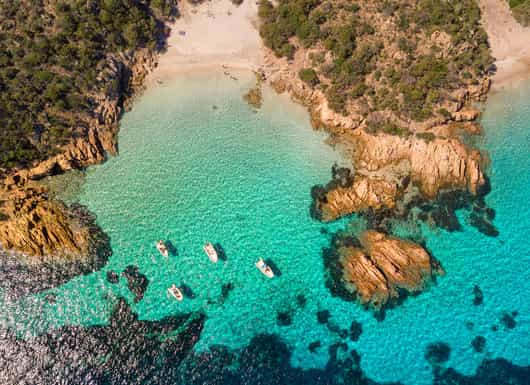
Glorious Sardinia, second only in size to Sicily and 120 miles off the toe of the ‘boot’, is an island full of surprises. On the northeast coast, the glamorous Costa Smeralda shimmers with yacht masts, billionaires and views from a Dolce & Gabbana perfume ad, but just a little further inland, life turns simple. Wild maquis blankets the hills and shepherds tend their flocks between pretty villages, and in the west, prehistoric nuraghi —mysterious stone towers — punctuate the landscape. Catalan-inspired towns like Alghero guard some of the island’s most exquisite beaches and in capital Cagliari, wanderings take you up steep hills and down to the shore. Life happens largely outdoors – long swims in Villasimius, hikes, and boat days along the rocky shoreline – or at the table: alfresco feasts of spit-roasted pig and slow-cooked lamb, ewe’s milk ricotta pasta, and plenty of mirto poured at the end of the night.
Get advice and suggestions to make this your perfect trip.
or call us on: +1 (646) 542 0667

Sardinia is one of the world’s original “Blue Zones” and has one of the highest concentrations of centenarians anywhere on earth. And with its culture of long lunches, daily walks and strong community ties, we’re not surprised!

Take the ferry and visit the island of Caprera in the La Maddalena Archipelago for glass-clear sea and often completely deserted beaches, lovely hiking trails, and Giuseppe Garibaldi’s last house.

Sardinia is larger than it looks and public transport is limited. Hiring a car will give you the freedom to explore hidden beaches and villages and enjoy as much of the island as possible.
Wet Season — a quieter time to visit
Crystalline air follows rainy fronts. From the high villages of Aritzo and Belvì, you can see Gennargentu's snowfields and the Tyrrhenian Sea on the same morning.
The Festa di Sant'Antonio Abate sees enormous bonfires lit across inland villages. In Mamoiada, the Mamuthones - masked men in shaggy sheepskins and copper cowbells - make their first appearance of the year.
Domus de janas and Giants' tombs feel especially atmospheric. The pre-nuragic stone monuments scattered across the Sassarese are among Europe's oldest funerary sites.
Wet Season — a good time to visit
Almond blossom carpets the western lowlands around Iglesias and the Sulcis. By mid-month, whole valleys turn pink-white as the surrounding macchia (fragrant scrub) wakes from winter dormancy.
Sa Sartiglia takes over Oristano on Carnival Sunday and Shrove Tuesday - a 500-year-old equestrian carousel where masked knights gallop full-tilt to lance a silver star with their swords.
Cagliari's Mercato di San Benedetto is at its best. Italy's largest covered food market has a seafood hall stacked with octopus, sea urchins and the day's lagoon catch.
Wet Season — a good time to visit
The first sunny stretches arrive on the southern coast. You’ll find Capo Carbonara's lagoons, Villasimius's beaches and Chia's dunes warm under midday sun, even if the sea remains chilly.
Holy Week in Alghero is a striking blend of Italian and Catalan traditions. The Good Friday torchlight descent through the medieval Catalan-speaking centre has no equivalent on mainland Italy.
Su Gorropu, one of Europe's deepest gorges, comes back into good hiking condition. The 500-metre limestone walls and wild River Flumineddu deliver Mediterranean drama at its sharpest.
Dry Season — a good time to visit
With spring now in full force, the macchia is at its most fragrant - cistus, rosemary, juniper and lentisk filling the warm air across hiking trails.
Wildflower hiking on the Supramonte and Iglesiente coast is at its finest. Conditions are ideal for tackling the Selvaggio Blu - Italy's most demanding multi-day coastal trek, from Pedra Longa to Cala Sisine.
Pranzo di Pasquetta sees Sardinians decamp en masse for countryside lunches. Join locals at an agriturismo for su porceddu - pork roasted on myrtle branches - for a relaxed Sardinian afternoon.
Dry Season — one of the best times to visit
Warm, dry days settle in and sea temperatures take a turn towards the swimmable, particularly along the south-facing Costa Rei and the sheltered coves of the Sinis Peninsula.
Sant'Efisio in Cagliari (1-4 May) is the island's largest religious procession. The saint's wooden statue travels by ox-drawn cart to Nora, accompanied by 3,000 islanders in traditional Sardinian costume.
Cannonau and Vermentino di Gallura producers open their cellars. The granite-grown white from Tempio Pausania, paired with fregola con arselle, defines the Sardinian spring meal.
Dry Season — one of the best times to visit
Long days stretch close to fifteen hours, with warm weather and almost no rain, perfect for a late dinner overlooking a stunning marina - Sardinia has plenty to choose from.
Belvì's Sagra delle Ciliegie (late June) celebrates the prized cherry harvest. Mountain villages around Aritzo lend their main streets to cherry tastings and caschetta pastries.
The Maddalena Archipelago becomes more accessible for sailing trips. Traditional gozzo charters from Palau and Cannigione cross to Budelli, Razzoli and Spargi.
Dry Season — a good time to visit
Hot, dry days settle in with relentless Sardinian sun. The Mistral picks up reliably from the north-west, providing welcome relief on coastal evenings around Alghero, Bosa and Stintino.
La Notte dei Poeti at Nora's ancient Roman theatre brings Greek tragedy under the stars. The 2,000-year-old amphitheatre, on the headland where Sardinia's Phoenician past meets the sea, hosts performances across mid-July.
Sea clarity reaches its absolute peak across the marine reserves. Tavolara, Capo Carbonara and the Asinara National Park deliver exquisite underwater visibility - among the best in the Mediterranean.
Dry Season — a quieter time to visit
Brief afternoon thunderstorms occasionally break the August heat. Skies clear afterwards with extraordinary visibility across Gallura's granite landscapes and the Supramonte's limestone cliffs.
Cala Luna and Cala Mariolu in the Gulf of Orosei deliver Sardinia at its iconic best - white-pebble beaches, limestone cliffs and Caribbean-blue water, accessible only by boat or via the Selvaggio Blu trek.
The last Sunday of August brings the Sagra del Redentore in Nuoro. Pilgrims and dancers from across Sardinia process up Monte Ortobene to the bronze statue of Christ - folk costumes and cantu a tenore singing.
Dry Season — one of the best times to visit
The heat eases noticeably, with the sea still at its summer warmth. The macchia begins its second flowering with autumn cyclamens appearing across the Barbagia.
Vendemmia gets under way across Sardinia's wine regions. The Cannonau vineyards of Mamoiada and Jerzu, Vermentino estates of Gallura, and Carignano del Sulcis producers all open cellars to harvest visits.
Pecorino sardo production finds its autumn stride with the year's young cheeses entering first ageing. Visit a working caseificio in the Marmilla and taste dolce, maturo and stagionato side by side.
Dry Season — one of the best times to visit
Mild, atmospheric days arrive with the macchia turning amber and the Gennargentu's chestnut and beech forests around Aritzo and Tonara colouring up dramatically.
Aritzo's Sagra delle Castagne e delle Nocciole (late October) celebrates the Gennargentu's chestnut and hazelnut harvest. The mountain village turns its main square into a roasted-chestnut and Cannonau festival.
Autunno in Barbagia transforms inland villages weekend by weekend. Mamoiada, Aritzo, Oliena and Orgosolo welcome visitors for pane carasau pressing, pecorino tastings, and weaving demonstrations in centuries-old houses.
Wet Season — a good time to visit
The Festa di San Martino brings the year's new wine to villages across the Marmilla and Sulcis. Sanluri's broad bean fair pairs young Cannonau and Vermentino with fresh beans, pecorino and homemade flatbreads.
The Mistral picks up notably, transforming the western coast around Alghero, Bosa and the Costa Verde into a windsurfer's playground. Capo Mannu becomes one of Italy's best wave-riding spots through the autumn.
Belvì's Sagra delle Castagne runs through November weekends. The mountain village's chestnut culture in full swing, roasted chestnuts, caschetta sweets and mountain honey abound.
Wet Season — a quieter time to visit
Mild, often crisp days between rain fronts make Sardinia a viable December escape, with daytime conditions staying considerably warmer than mainland Italy.
Sebadas - sweet pastries filled with fresh pecorino and drizzled with bitter mountain honey - anchor December dinners across the island. The mountain dessert from Barbagia, eaten warm with mirto liqueur, captures inland Sardinia in one bite.
Cagliari's Christmas markets fill the Bastione di Saint-Remy and Largo Carlo Felice. Modest by mainland Italian standards but distinctly Sardinian - handmade filigree silver, juniper-wood crafts, mirto bottles and local pastries.


Why travel with Timbuktu?

We've been crafting one-of-a-kind journeys since 2014 — over 2,500 trips across 40+ countries, each one built from scratch around your interests and dreams.

Our team only recommends places they've slept in, eaten in, and happily keep going back to. Condé Nast Traveler named 11 of them Top Travel Specialists in 2026, and Travel+Leisure made three A-List Advisors.

Travel+Leisure's readers voted us the World's No.1 Tour Operator in 2024 and No.2 in 2025 — the travel industry's biggest readers' award, judged by people who actually travel.

$50 from every booking goes to female empowerment, tech education, and conservation projects across the countries we love. We have donated $78,000 so far – and it's going up!

Your travel specialist is with you the whole way, dreaming up the trip, building the itinerary, checking you in, and answering the 2am question from the other side of the world..

We are rated 4.9 out of 5 from 997 verified Feefo reviews. And these are the words of people who actually went, not us talking about ourselves.
11 Condé Nast Traveler Top Travel Specialists 2026

No. 1 & No. 2 Tour Operator in Travel + Leisure's Best Awards 2024 & 2025

Best Booking Platform in Women's Health Travel Awards 2025

Travel Specialist voted as Latin America A-List Travel Advisor 2025

"Timbuktu can take relatively complex and slightly amorphous travel plans and transform them into a well-organized, perfectly tailored trip."










.jpg)
,url-https%3A%2F%2Fassets.waybird.com%2Fcdn-cgi%2Fimage%2Fwidth%3D12%2Cformat%3Dauto%2Fhttps%3A%2F%2Fassets.waybird.com%2Fimages%2Fmap%2Fpin-primary-outlined.png(8.984680664652554,39.010441652801546),url-https%3A%2F%2Fassets.waybird.com%2Fcdn-cgi%2Fimage%2Fwidth%3D12%2Cformat%3Dauto%2Fhttps%3A%2F%2Fassets.waybird.com%2Fimages%2Fmap%2Fpin-primary-outlined.png(9.263006180075761,40.94541937233067),url-https%3A%2F%2Fassets.waybird.com%2Fcdn-cgi%2Fimage%2Fwidth%3D12%2Cformat%3Dauto%2Fhttps%3A%2F%2Fassets.waybird.com%2Fimages%2Fmap%2Fpin-primary-outlined.png(9.299318415758577,40.05090599707157),url-https%3A%2F%2Fassets.waybird.com%2Fcdn-cgi%2Fimage%2Fwidth%3D12%2Cformat%3Dauto%2Fhttps%3A%2F%2Fassets.waybird.com%2Fimages%2Fmap%2Fpin-primary-outlined.png(9.014830011403873,40.11805669311588),url-https%3A%2F%2Fassets.waybird.com%2Fcdn-cgi%2Fimage%2Fwidth%3D12%2Cformat%3Dauto%2Fhttps%3A%2F%2Fassets.waybird.com%2Fimages%2Fmap%2Fpin-primary-outlined.png(9.014830011403873,40.15507699600344),url-https%3A%2F%2Fassets.waybird.com%2Fcdn-cgi%2Fimage%2Fwidth%3D12%2Cformat%3Dauto%2Fhttps%3A%2F%2Fassets.waybird.com%2Fimages%2Fmap%2Fpin-primary-outlined.png(8.990805538076286,39.70612708538362),url-https%3A%2F%2Fassets.waybird.com%2Fcdn-cgi%2Fimage%2Fwidth%3D12%2Cformat%3Dauto%2Fhttps%3A%2F%2Fassets.waybird.com%2Fimages%2Fmap%2Fpin-primary-outlined.png(9.003584199312089,40.123027701939364),url-https%3A%2F%2Fassets.waybird.com%2Fcdn-cgi%2Fimage%2Fwidth%3D12%2Cformat%3Dauto%2Fhttps%3A%2F%2Fassets.waybird.com%2Fimages%2Fmap%2Fpin-primary-outlined.png(9.017317108335712,40.12092746136811),url-https%3A%2F%2Fassets.waybird.com%2Fcdn-cgi%2Fimage%2Fwidth%3D12%2Cformat%3Dauto%2Fhttps%3A%2F%2Fassets.waybird.com%2Fimages%2Fmap%2Fpin-primary-outlined.png(9.309613624665317,39.20559042772771),url-https%3A%2F%2Fassets.waybird.com%2Fcdn-cgi%2Fimage%2Fwidth%3D12%2Cformat%3Dauto%2Fhttps%3A%2F%2Fassets.waybird.com%2Fimages%2Fmap%2Fpin-primary-outlined.png(9.66110228915962,40.08870992758199),url-https%3A%2F%2Fassets.waybird.com%2Fcdn-cgi%2Fimage%2Fwidth%3D12%2Cformat%3Dauto%2Fhttps%3A%2F%2Fassets.waybird.com%2Fimages%2Fmap%2Fpin-primary-outlined.png(9.362454442637292,41.050077581354316)/auto/600x400?access_token=pk.eyJ1IjoidGltYnVrdHV0cmF2ZWwiLCJhIjoiY2poMGw1eHpkMmRkbDJ6bW8xYWZ5OGpjYyJ9.PYvAO7lUJ40SOpGvwmQLqw&attribution=false&logo=false)