Sicily Trips & Tours
Sicily
Volcanic, ancient and almost aggressively delicious, Sicily has been accumulating wonders for millennia and shows absolutely no sign of stopping.
Sicily
Volcanic, ancient and almost aggressively delicious, Sicily has been accumulating wonders for millennia and shows absolutely no sign of stopping.

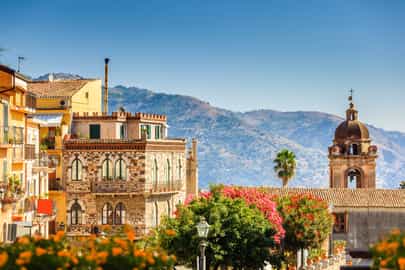
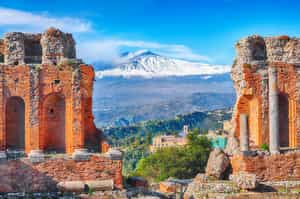
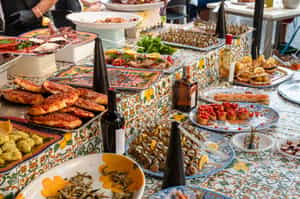
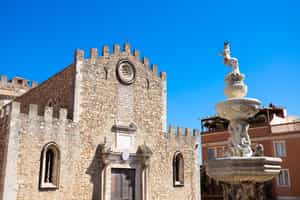
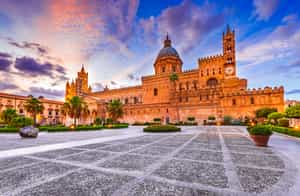
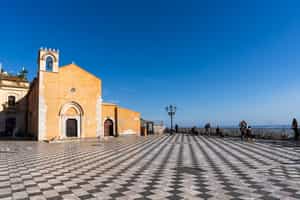
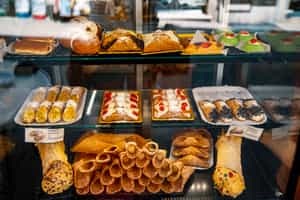
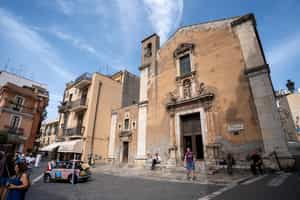
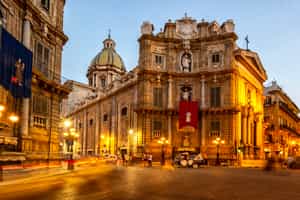
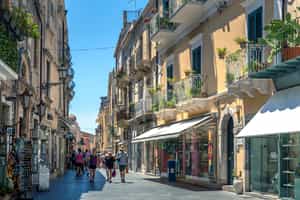
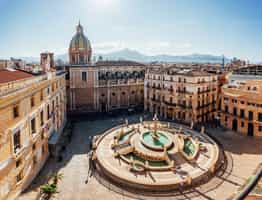
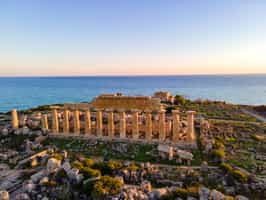
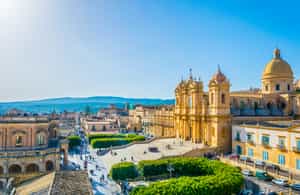
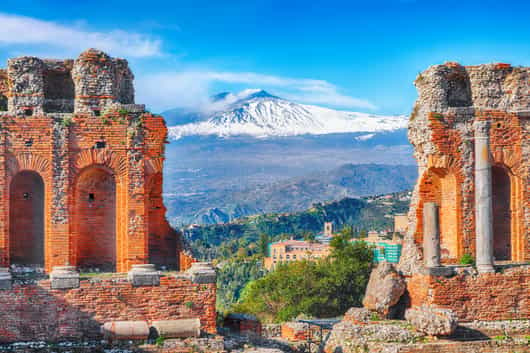
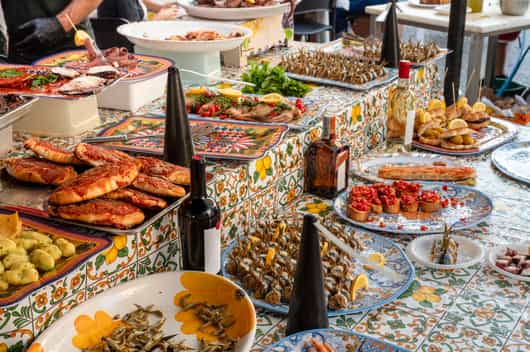
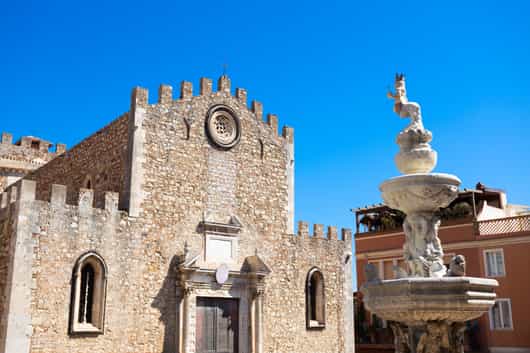
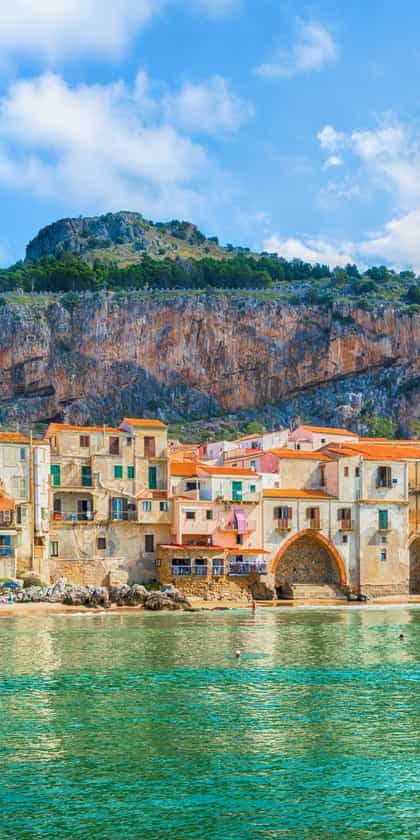
Separated by a narrow stretch of sea, Sicily is worlds apart from the mainland. It’s the kind of island where stress feels out of place, helped along by the stunning scenery in every direction, full of mountains, searing blue seas and flaxen sands. The island itself was ruled by many nations over the years, influencing everything from architecture to the cuisine, and Greek temples sit next to perfectly-preserved Baroque paintings and glittering Arab-Norman mosaics. Whenever the opportunity arises, take a moment to sample the island’s signature dishes including caponata, gambero rosso (raw red prawns) and cannoli filled with creamy ricotta – and in Palermo, pay a visit to one of the many markets, piled high with swordfish, citrus and arancini. Inland, almond trees and pistachio groves abound and a visit to the adored hillside town of Taormina and nearby Noto is a must. And then there are the hotels. You’ll find sprawling five-star residences that are every bit as White Lotus as they sound, designer boutiques and guesthouses that will thrust you into the heart of Sicilian family life (and the cucina).
Get advice and suggestions to make this your perfect trip.
or call us on: +1 (646) 542 0667

No two places will ever feel the same, from Baroque hill towns to wild coastlines and volcanic slopes, Sicily is varied, characterful and always interesting.

Head inland to towns like UNESCO-listed Noto or Modica for ornate Baroque architecture and fewer crowds, or explore the in-the-know gems of the Aeolian Islands with their fascinating geography and great beaches.

The summer heat in Sicily is serious, as are the crowds. If you can, time a visit for May, June or September to revel in gentle weather and slightly less busy hotspots.
Wet Season — a good time to visit
Cold and somewhat rainy, this is a wonderfully quiet time to explore major sights like the Valley of the Temples and Monreale.
Mount Etna can be admired at its most dramatic – snow-capped and brooding, with skiing on the slopes possible at Piano Provenzana and Rifugio Sapienza.
Blood orange season in full force, with sanguinello, tarocco and moro varieties from the Catania plain flooding markets across the island.
Wet Season — a good time to visit
Mild and bright between fronts, temperatures climb to 14-17° and the southern coast enjoys particularly sunny stretches.
During the early days of February, Catania's Festa di Sant'Agata takes place in a series of candlelit processions – one of the world’s greatest religious festivals.
In late-February and into early-March, pink-white almond blossoms carpet the Valley of the Temples, celebrated during the Almond Blossom Festival in Agrigento.
Wet Season — a good time to visit
Spring brings with it a warming of temperatures and wildflowers blooming across Sicily’s interior.
The Sagra del Mandorlo in Fiore continues into early March in Agrigento with almond blossom and folkloric processions among the Greek temples.
Wild fennel, broad beans and the first artichokes hit the markets – Sicilian spring cooking starts shifting visibly toward the green and herbal.
Dry Season — one of the best times to visit
Mount Etna hiking opens at all altitudes – snow recedes, wildflowers emerge on the lava slopes, and the lower trails are at their most photogenic.
Sea swimming is still cool (around 17°C) but bold souls dive in, while beach clubs in Cefalù, Mondello and San Vito Lo Capo begin reopening for the season.
Vizzini's Sagra della Ricotta (late April) is a prominent local cheese festival. The Catania-province town is in full sheep's-milk mode, with cassata and cannoli on every corner.
Dry Season — one of the best times to visit
Widely-regarded as the best month to visit Sicily, temperatures are balmy, the sea is warming and granita of every flavour stakes its claim.
Sea temperatures climb to around 19-20°C. Mondello, Cefalù and San Vito Lo Capo's white-sand beaches are genuinely swimmable and still uncrowded.
The Greek Theatre Festival at Syracuse begins where classical tragedies are performed in the 5th-century BC theatre, exactly as they were 2,500 years ago.
Dry Season — one of the best times to visit
San Vito Lo Capo, Mondello and the Egadi Islands are on top form with turquoise water, white sand and excellent snorkelling around Favignana's tonnara.
Stromboli's volcanic activity is best viewed by night with hydrofoil excursions running at full schedule.
Tomato, eggplant and sweet pepper season properly begins. Caponata, parmigiana and pasta alla Norma appear at their sun-ripened best on every Sicilian table.
Dry Season — a good time to visit
Temperatures in Sicily reach well into the 30s, so inland archaeological sites like Agrigento and Selinunte are best at opening or after 5pm.
Beach season is in full swing with sea temperatures reaching 25°C and the Egadi, Aeolian and Pelagie Islands ablaze under the Mediterranean sunshine.
Watermelon, peaches, prickly pear figs and the first tomato harvest define the markets, which you can enjoy late into the evening.
Dry Season — a quieter time to visit
Temperatures are scorching and Ferragosto (starting on the 15th of August) brings locals to the coast in their droves.
Sea swimming and island hopping are a firm favourite with temperate water and beach clubs running until late.
Mount Etna is often very active during this time, making for a staggering backdrop in the evenings.
Dry Season — one of the best times to visit
Sea swimming remains fantastic, while crowds thin dramatically and the humidity eases.
Grape harvest gets going across Etna's slopes and the Marsala plain – Nerello Mascalese is particularly worth a visit.
The Cous Cous Fest takes over San Vito Lo Capo for ten days with international chefs competing in one of the Mediterranean's great food festivals.
Wet Season — one of the best times to visit
Enjoy glorious early-autumn warmth and the sea still at swimmable temperatures (around 23°C) in the first half of October.
Harvest energy is in full swing across the island. Zafferana Etnea's Ottobrata festival runs every Sunday in October, when apples, mushrooms, chestnuts, honey and grapes from Etna's slopes are celebrated.
Capizzi's Nebrodi black truffle festival and the Bronte pistachio festival in early October overlap, defining the eastern interior's autumn food calendar.
Wet Season — a good time to visit
Sicily experiences the wettest weather of the year, and the Aeolian and Egadi Islands largely shut down for winter.
Olive harvest peaks across the island with village frantoios producing new-pressed extra virgin oil, unfiltered and peppery.
Agira's cassatella di ricotta festival celebrates the season's defining sheep's milk pastries.
Wet Season — a good time to visit
Mount Etna can be skiable in snowy years. With luck, there’ll be snow on the summit while citrus groves fruit at sea level in spectacular contrast.
Modica's Cioccobarocco chocolate festival – the Aztec-influenced cold-pressed chocolate of Modica is celebrated throughout the baroque town's atmospheric streets.
Christmas markets fill the baroque streets of Catania, Palermo and the Val di Noto. Caltagirone's ceramic nativity scenes are among Italy's finest.


Why travel with Timbuktu?

We've been crafting one-of-a-kind journeys since 2014 — over 2,500 trips across 40+ countries, each one built from scratch around your interests and dreams.

Our team only recommends places they've slept in, eaten in, and happily keep going back to. Condé Nast Traveler named 11 of them Top Travel Specialists in 2026, and Travel+Leisure made three A-List Advisors.

Travel+Leisure's readers voted us the World's No.1 Tour Operator in 2024 and No.2 in 2025 — the travel industry's biggest readers' award, judged by people who actually travel.

$50 from every booking goes to female empowerment, tech education, and conservation projects across the countries we love. We have donated $78,000 so far – and it's going up!

Your travel specialist is with you the whole way, dreaming up the trip, building the itinerary, checking you in, and answering the 2am question from the other side of the world..

We are rated 4.9 out of 5 from 997 verified Feefo reviews. And these are the words of people who actually went, not us talking about ourselves.
11 Condé Nast Traveler Top Travel Specialists 2026

No. 1 & No. 2 Tour Operator in Travel + Leisure's Best Awards 2024 & 2025

Best Booking Platform in Women's Health Travel Awards 2025

Travel Specialist voted as Latin America A-List Travel Advisor 2025

"Timbuktu can take relatively complex and slightly amorphous travel plans and transform them into a well-organized, perfectly tailored trip."










.jpg)
,url-https%3A%2F%2Fassets.waybird.com%2Fcdn-cgi%2Fimage%2Fwidth%3D12%2Cformat%3Dauto%2Fhttps%3A%2F%2Fassets.waybird.com%2Fimages%2Fmap%2Fpin-primary-outlined.png(13.362778322493057,38.115128258339304),url-https%3A%2F%2Fassets.waybird.com%2Fcdn-cgi%2Fimage%2Fwidth%3D12%2Cformat%3Dauto%2Fhttps%3A%2F%2Fassets.waybird.com%2Fimages%2Fmap%2Fpin-primary-outlined.png(15.291091707196687,37.85779343836904),url-https%3A%2F%2Fassets.waybird.com%2Fcdn-cgi%2Fimage%2Fwidth%3D12%2Cformat%3Dauto%2Fhttps%3A%2F%2Fassets.waybird.com%2Fimages%2Fmap%2Fpin-primary-outlined.png(13.35831512706038,38.114317903594234),url-https%3A%2F%2Fassets.waybird.com%2Fcdn-cgi%2Fimage%2Fwidth%3D12%2Cformat%3Dauto%2Fhttps%3A%2F%2Fassets.waybird.com%2Fimages%2Fmap%2Fpin-primary-outlined.png(15.2869718344896,37.85779343836904),url-https%3A%2F%2Fassets.waybird.com%2Fcdn-cgi%2Fimage%2Fwidth%3D12%2Cformat%3Dauto%2Fhttps%3A%2F%2Fassets.waybird.com%2Fimages%2Fmap%2Fpin-primary-outlined.png(13.364151613395418,38.11647882959997),url-https%3A%2F%2Fassets.waybird.com%2Fcdn-cgi%2Fimage%2Fwidth%3D12%2Cformat%3Dauto%2Fhttps%3A%2F%2Fassets.waybird.com%2Fimages%2Fmap%2Fpin-primary-outlined.png(15.284982361862838,37.851573380868295),url-https%3A%2F%2Fassets.waybird.com%2Fcdn-cgi%2Fimage%2Fwidth%3D12%2Cformat%3Dauto%2Fhttps%3A%2F%2Fassets.waybird.com%2Fimages%2Fmap%2Fpin-primary-outlined.png(13.365868227023368,38.117289160367626),url-https%3A%2F%2Fassets.waybird.com%2Fcdn-cgi%2Fimage%2Fwidth%3D12%2Cformat%3Dauto%2Fhttps%3A%2F%2Fassets.waybird.com%2Fimages%2Fmap%2Fpin-primary-outlined.png(15.285411516451445,37.85164115319148),url-https%3A%2F%2Fassets.waybird.com%2Fcdn-cgi%2Fimage%2Fwidth%3D12%2Cformat%3Dauto%2Fhttps%3A%2F%2Fassets.waybird.com%2Fimages%2Fmap%2Fpin-primary-outlined.png(13.35831512706038,38.11539837458954),url-https%3A%2F%2Fassets.waybird.com%2Fcdn-cgi%2Fimage%2Fwidth%3D12%2Cformat%3Dauto%2Fhttps%3A%2F%2Fassets.waybird.com%2Fimages%2Fmap%2Fpin-primary-outlined.png(12.836633938482118,37.584429123301284),url-https%3A%2F%2Fassets.waybird.com%2Fcdn-cgi%2Fimage%2Fwidth%3D12%2Cformat%3Dauto%2Fhttps%3A%2F%2Fassets.waybird.com%2Fimages%2Fmap%2Fpin-primary-outlined.png(13.5894812535186,37.29716901047814),url-https%3A%2F%2Fassets.waybird.com%2Fcdn-cgi%2Fimage%2Fwidth%3D12%2Cformat%3Dauto%2Fhttps%3A%2F%2Fassets.waybird.com%2Fimages%2Fmap%2Fpin-primary-outlined.png(15.065727435927542,36.89226677248276)/auto/600x400?access_token=pk.eyJ1IjoidGltYnVrdHV0cmF2ZWwiLCJhIjoiY2poMGw1eHpkMmRkbDJ6bW8xYWZ5OGpjYyJ9.PYvAO7lUJ40SOpGvwmQLqw&attribution=false&logo=false)